


On April 15, 2026, New York’s mayor, Zohran Mamdani, stood on the sidewalk outside 220 Central Park South, pointed his phone at the building, and filmed a video. Behind him: Kenneth Griffin’s $238 million penthouse, 24,000 square feet of Central Park views, empty most of the year because Griffin lives in Miami. Mamdani, a member of the Democratic Socialists of America, had just signed a pied-à-terre tax. He looked into the camera and said, more or less: when I ran for mayor, I said I was going to tax the rich. Today we’re taxing the rich.
The video went viral. Griffin threatened to move Citadel’s investments to Miami. The familiar gears of the American culture war engaged.
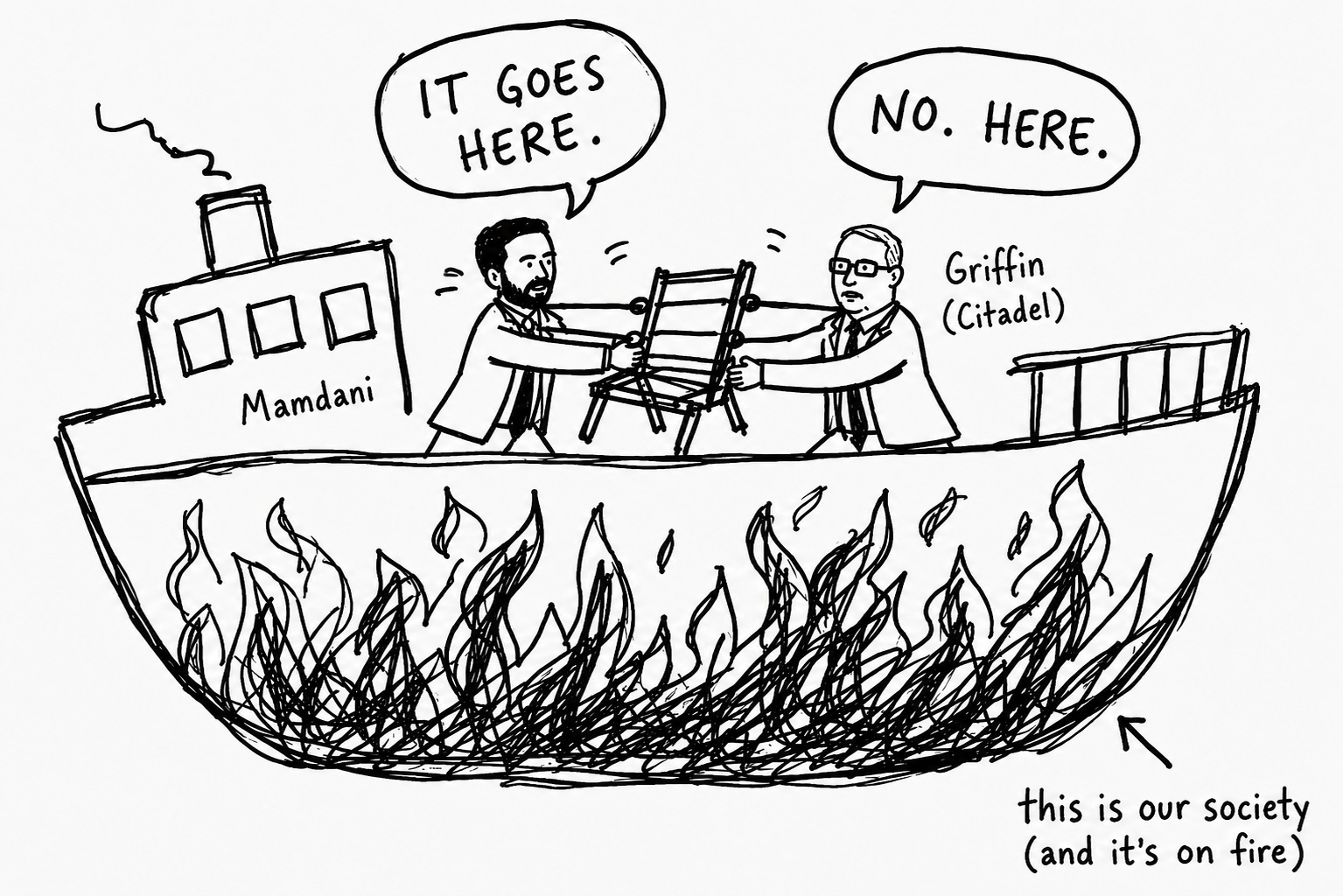
I’ve been thinking about this scene for weeks. The politics aren’t the reason. The politics are familiar: rich guy versus populist mayor, tax-the-wealthy versus capital-flight threats, left versus right. You’ve seen this movie.
I keep coming back to it because I think the frameworks people are using to interpret the moment are too small.
The obvious frame: socialism versus capitalism. A DSA mayor takes on a hedge fund billionaire. Class warfare, American edition.
A step up in sophistication: populism versus the establishment. A young outsider channels resentment against an out-of-touch elite. The pendulum swings.
Both frames fit. Both miss the thing underneath.
The thing underneath is an engine. It has been running for about five hundred years. It powered the rise of the Dutch Republic, the British Empire, the American century. It won the Cold War. It built the city that Mamdani and Griffin are both standing in.
That engine is undergoing a mutation. AI is reaching into its internal machinery and altering the conditions that made it work. Neither Mamdani nor Griffin has the vocabulary to describe what’s happening, and I’m not sure anyone else does either. But I’ve spent enough time looking at the pieces that I want to try to lay them out.
To see the mutation, you first need to see the engine. And to see the engine, you need to start in Amsterdam, in the year 1602.
The Original Term Sheet
The Dutch East India Company did something in 1602 that no one had done before. It sold shares to the public on the Amsterdam Stock Exchange. Ordinary citizens could walk in, put down guilders, and own a fractional piece of a trading venture to the East Indies.
This gets taught in business schools as a financial innovation. A clever capital-raising mechanism. That framing undersells it by three orders of magnitude.
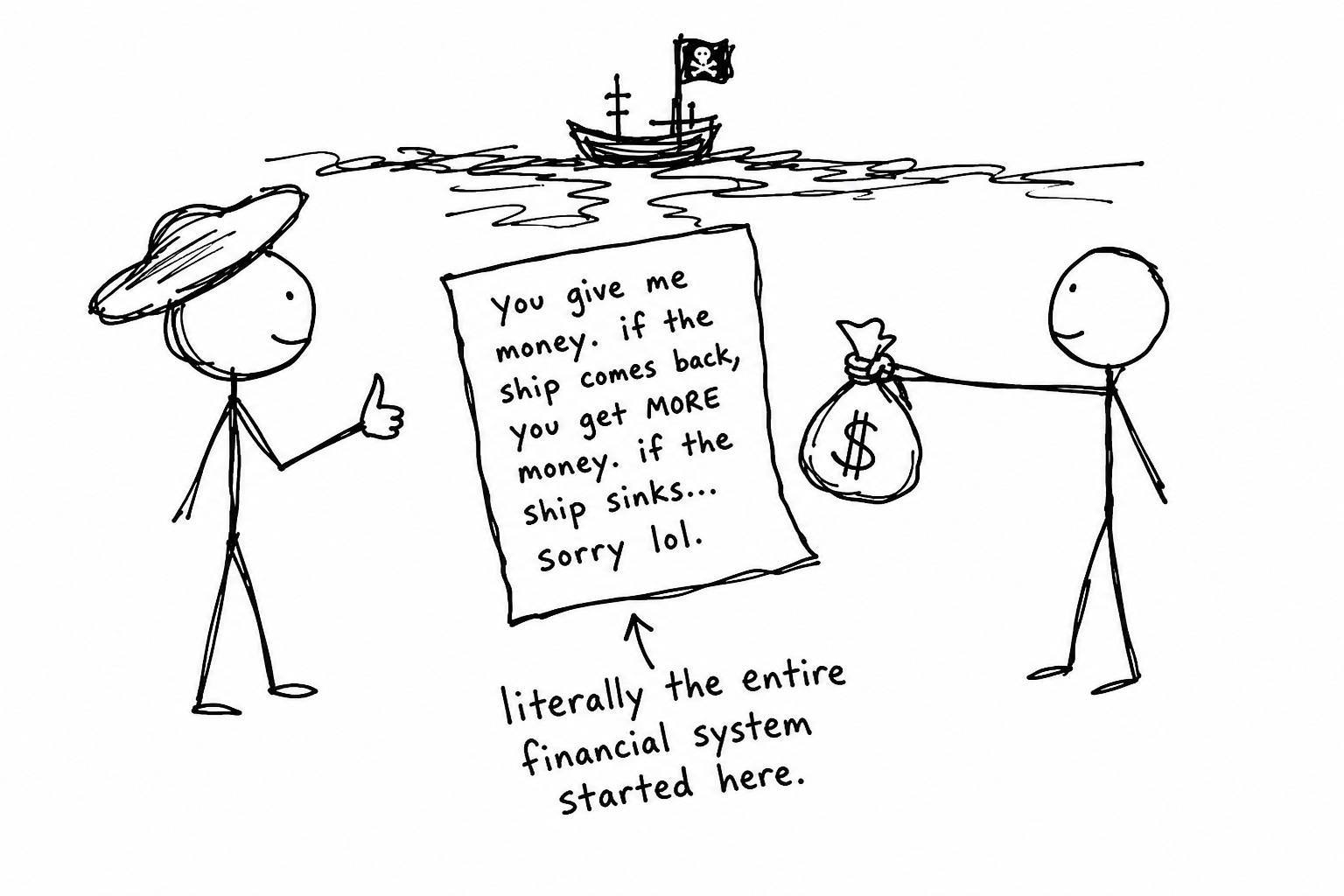
Think about what the Dutch East India Company was asking people to do. Hand your money to strangers. The strangers will use it to outfit wooden ships. The ships will sail to the other side of the planet, through storms, past pirates, across oceans where diseases no European doctor could treat ran through crews like fire. The round trip takes two years. The ship might not come back. Your money might end up on the ocean floor somewhere off the Cape of Good Hope.
Who takes that deal?
You take that deal if you believe a specific promise. The promise, encoded in a share certificate, says: whatever profits this venture generates, your proportional cut belongs to you. Not the king’s. Not the company director’s to skim. Yours. Courts will enforce this. You can sell the share to someone else if your nerve fails. You can leave it to your children. The returns are yours.
This was, if you want to think about it in modern terms, the original term sheet. And it set something in motion that had been stuck for thousands of years of human commerce. Once people believed that the future returns belonged to them, they put capital at risk. And once capital was at risk in sufficient volume, it started flowing toward the most productive available ventures, pulled by each investor’s pursuit of their own upside. No king pointed the way. No committee allocated the funds. The credibility of the property right, the trust in that single promise, was the entire activation mechanism.
The reverse makes the point cleaner.
In the early 1930s, Joseph Stalin’s government forced millions of Ukrainian and Russian farmers into collective farms. The arrangement: your land, your animals, your tools now belong to “the collective.” You’ll work the collective’s fields. The output goes to the state plan
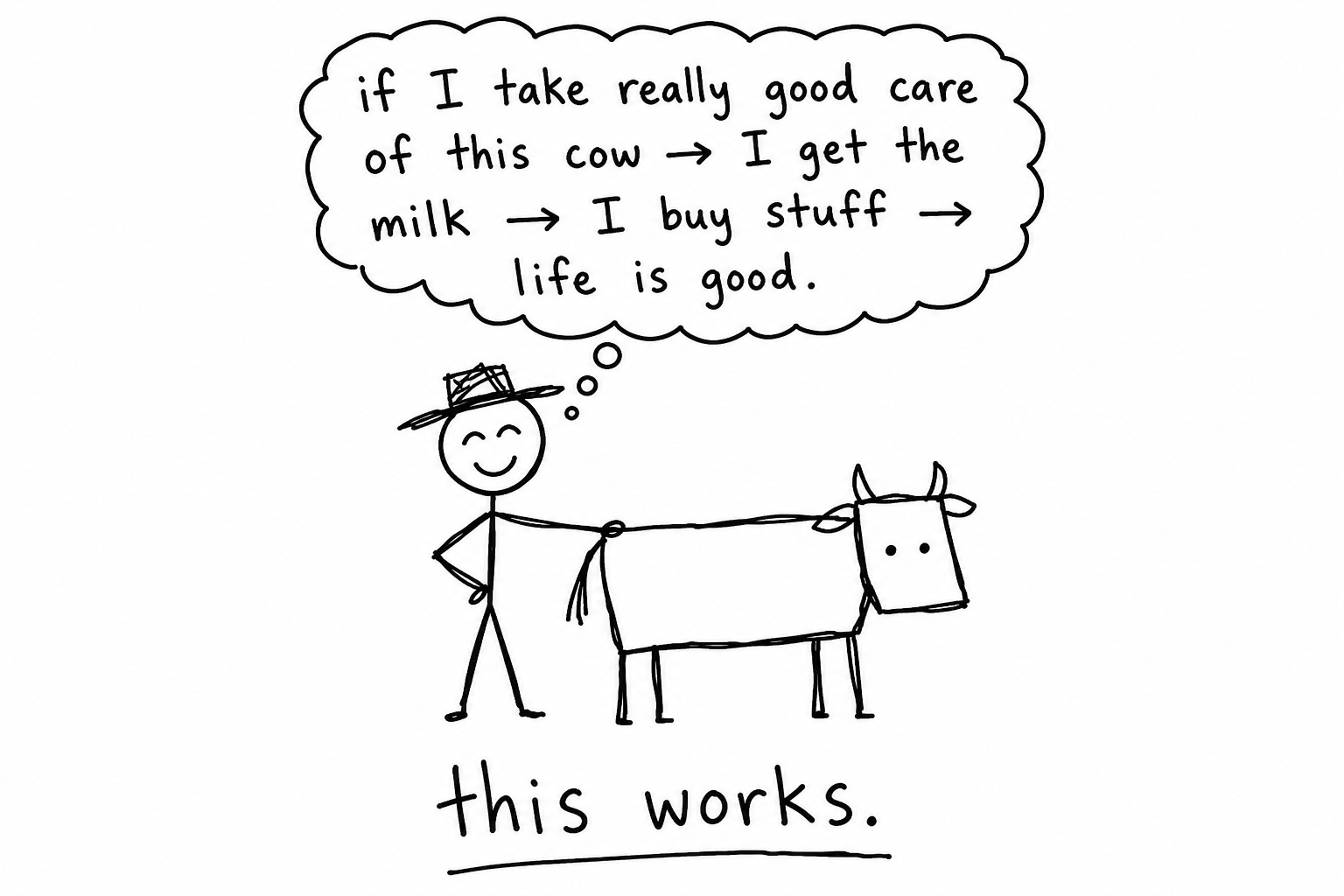
The farmers processed the economics of this arrangement faster than the ideologues who designed it. If the extra wheat you grow by working twice as hard goes to the collective, the incentive to work twice as hard vanishes. And if the cow in your barn will become collective property next week, the rational move is to slaughter it tonight, salt the beef, and feed your family before someone in Moscow decides where the meat goes.
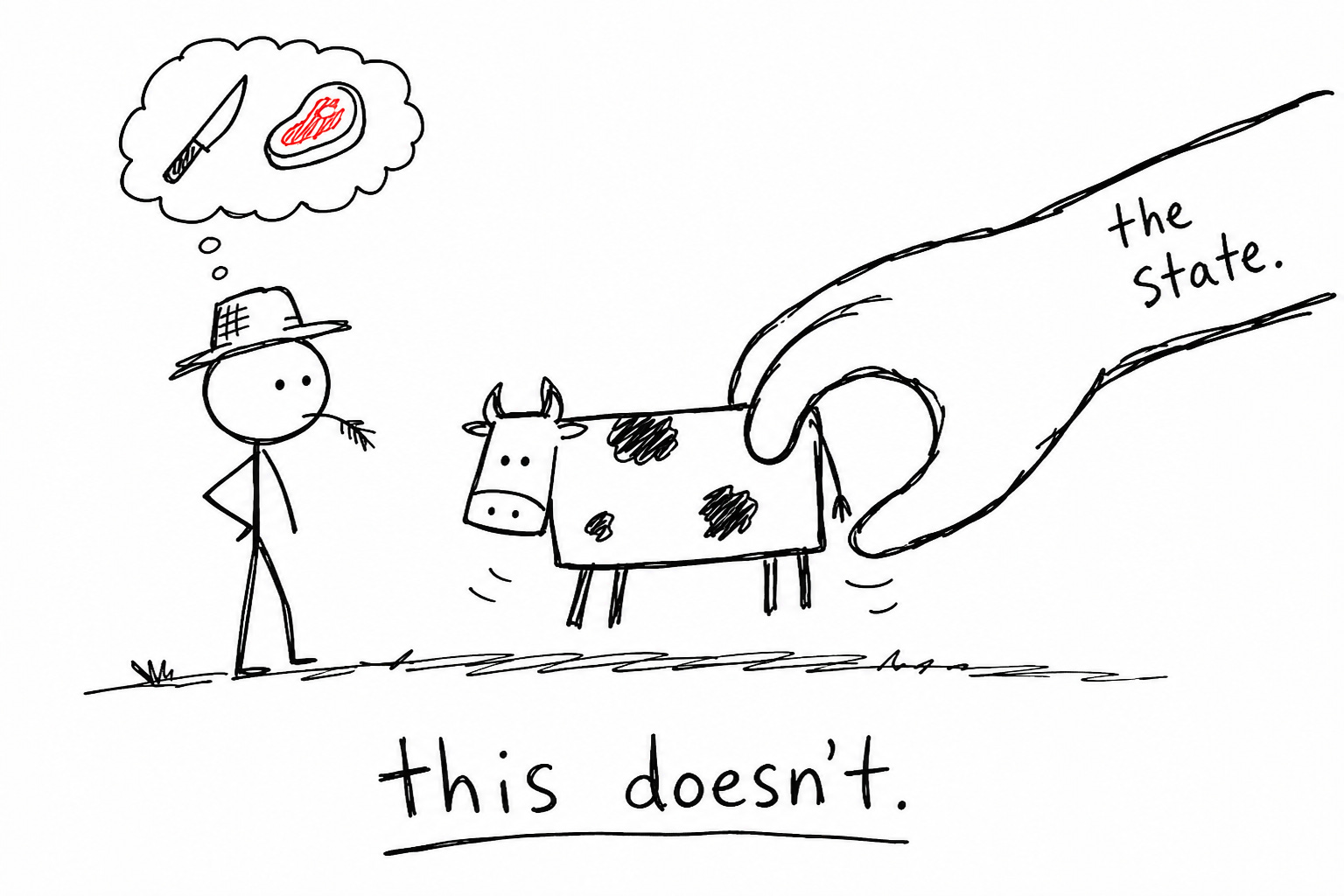
They did this across the Soviet countryside. Livestock herds dropped by close to half within two years. Millions of animals, killed by their owners, in a wave of collective liquidation that no central planner had anticipated.
The farmers weren’t saboteurs. They were doing the math that every investor, every entrepreneur, every person with a stake in the future does. When the future doesn’t belong to you, you eat the future today. You pull the money off the table. You slaughter the cow.
Property rights are the first ingredient in the engine. They’re the reason anyone bothers to invest, build, take risk, or think about tomorrow rather than today. Remove them, and the downstream machinery goes still.
The Poker Table
The second ingredient is harder to see. It works in the background. But it carries as much weight as the first.
Picture a poker table the size of the world. Millions of seats. Each player holds different cards: different information, different judgment, different appetite for risk. They bet against each other, raise, fold, call. No player sees all the cards in play. But because millions of them are betting, each one acting on a different sliver of reality, the prices that emerge from all these overlapping wagers turn out to be more accurate, in aggregate, than the best estimate any single player could produce.
This is what the Austrian economist Friedrich Hayek figured out in 1945. He published it as an academic paper. The plain-language version: a crowd of ordinary people, each acting on local knowledge, will price goods and risks with more precision than a panel of geniuses working from a central office.
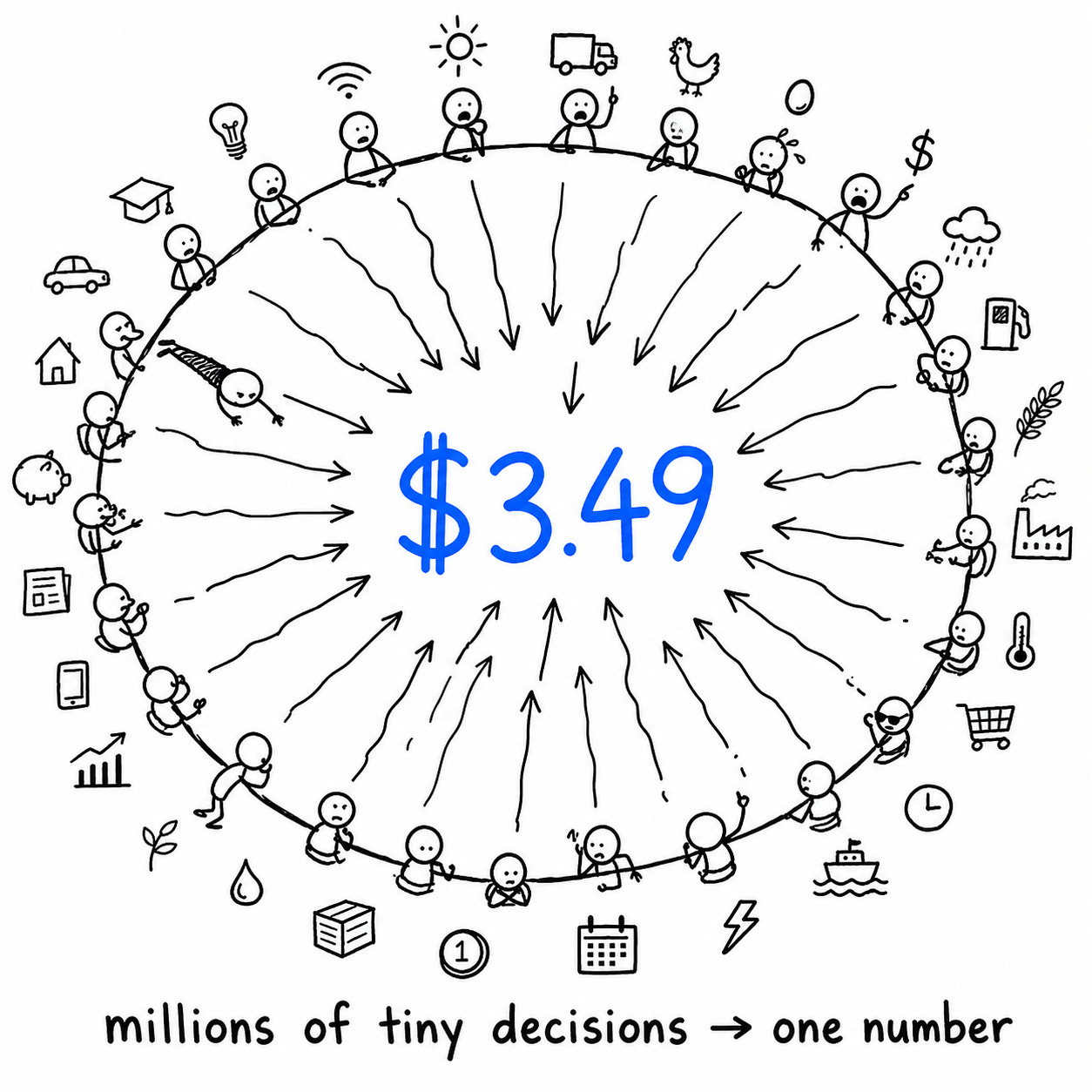
Think about what a single price contains. The price of a dozen eggs in a Manhattan grocery store encodes information about the number of laying hens within trucking range, the cost of feed corn in Iowa, diesel prices for the delivery fleet, warehouse rent in New Jersey, wages for the drivers, seasonal demand shifts around Easter, competition from the bodega down the block, and about four hundred other variables that no individual person tracks. All of that information, compressed into one number on a shelf tag. No committee compiled it. No bureau calculated it. Millions of independent decisions by farmers, truckers, wholesalers, grocers, and shoppers, each person processing one tiny piece of the picture, fed into the system. The price is what came out the other end.
This is where a Soviet mathematician named Viktor Glushkov enters the story, and I find his story difficult to put down once I’ve picked it up.
In 1962, Glushkov pitched the Politburo a plan. Build a computer network covering the entire Soviet Union. Wire every factory, every warehouse, every rail depot, every collective farm into a single data grid. Run mathematical models on the data to compute optimal resource allocation in real time, across the whole economy. No prices needed. Pure computation.
He called the system OGAS: the All-State Automated Management System. Estimated cost: about 20 billion rubles, in the same range as the Soviet space program. Projected timeline: ten to fifteen years.
Glushkov’s reasoning was clean. Hayek says central planners can’t match the information-aggregation power of prices? Fine. Hayek was writing in 1945, before computers. Build a computer big enough, feed it enough data, and you can do what the price system does, without the price system. Replace the poker table with an equation.
The Politburo killed the project. The reasons were a cocktail of the bureaucratic and the structural. Planning ministry officials didn’t want a computer deciding their budgets; a computer that optimizes resource allocation is a computer that makes middle managers redundant, and middle managers, then as now, tend to notice when someone’s building a machine to replace them. The military didn’t want to share resources. And the most basic problem: the computers of 1962, room-sized arrays of vacuum tubes and early transistors, couldn’t come close to processing real-time data from a 200-million-person economy.
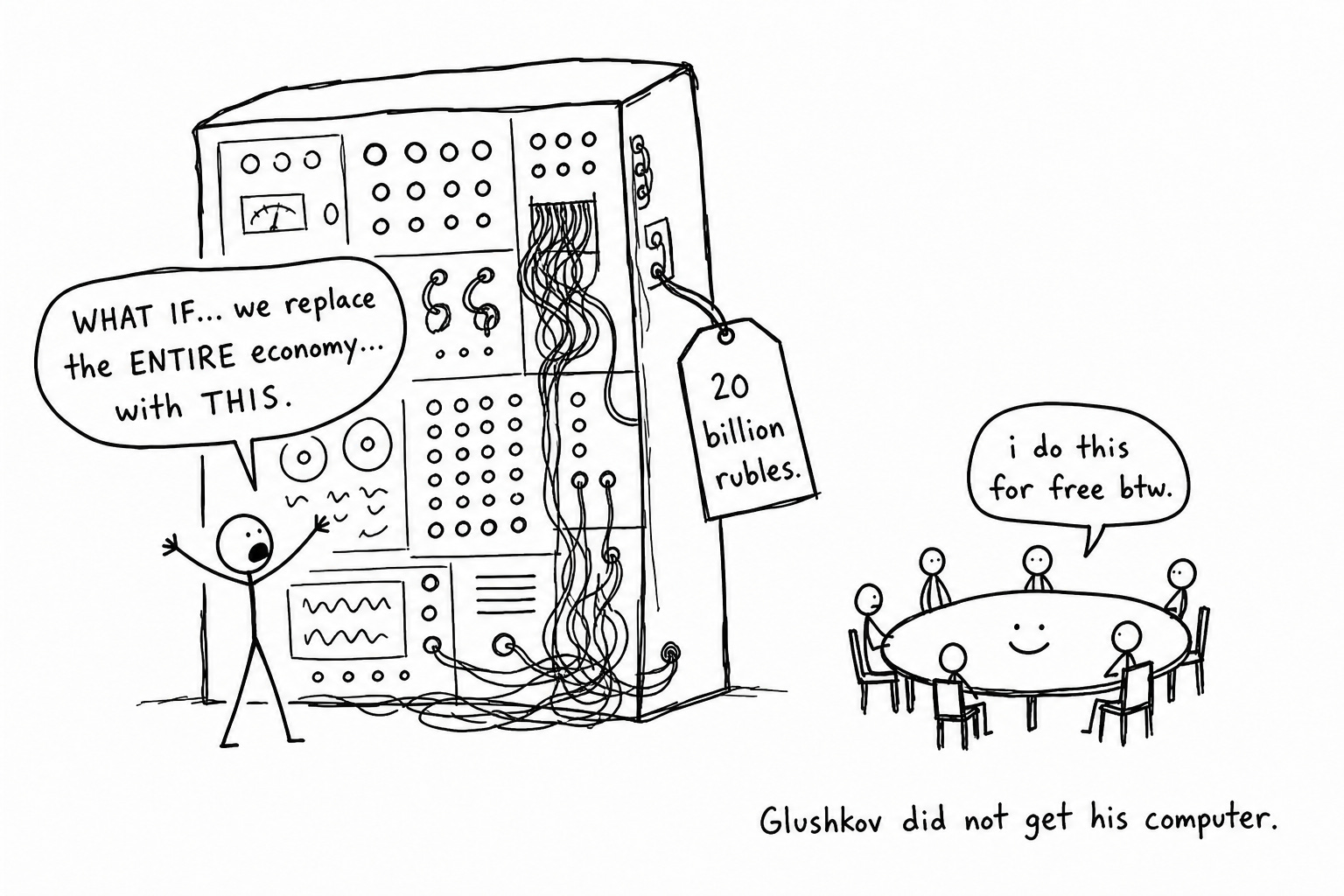
Glushkov was right about the concept. He was sixty years too early for the hardware.
The hardware exists now. We call the systems running on it AI.
But they haven’t rescued central planning. The Soviet Union collapsed decades before ChatGPT launched. There is no centralized economy left to optimize.
Instead, these systems are doing something Glushkov never considered. I’ll come back to this.
The Math That Won the Cold War
Property rights and market pricing are the engine’s two structural components. Time is the force that reveals what the engine can do when you let it run.
In 1626, Peter Minuit paid about $24 in equivalent Dutch guilders to the Lenape people for the island of Manhattan. If the Lenape had invested that $24 at 6% compound annual return, the sum in 2024 would exceed $200 billion, a figure in the same neighborhood as Manhattan’s current assessed real estate value.
Twenty-four dollars. Four hundred years. Two hundred billion.
Let that math sit for a moment, because it contains something counterintuitive. Nobody did anything brilliant during those four centuries. Nobody hit a home run. Nobody made a killing. The 6% return is boring. It’s average. It’s the kind of return you don’t write home about. And yet, compounded over enough time, average performance at a boring rate turns $24 into a sum that can buy a significant fraction of the most valuable island on earth.
A 7% annual return doubles your money in ten years. Quadruples it in twenty. Multiplies it about a thousandfold in a century, which is four generations. A hundred years of quiet, consistent, boring 7%.
Human brains are bad at this. Our intuitions, calibrated on the African savanna where everything important scaled in straight lines (walk twice as far, cover twice the ground; carry twice the weight, burn twice the energy), have no built-in module for exponential growth. You have to override your instincts and run the numbers. The numbers are always bigger than you expect.
Capitalism won the Cold War on these numbers. In any given year of the 1950s and 1960s, Soviet GDP growth sometimes matched American growth. Single-year snapshots made the race look close. But compound interest doesn’t care about snapshots. It cares about accumulation. Each year’s small efficiency edge on the capitalist side, stacked on top of itself, compounded for four decades, produced a gap so visible that you could see it with your eyes the night the Berlin Wall opened. East Germans walking through the checkpoints into West Berlin in November 1989 were walking into forty years of compound interest differential made visible in neon signs, stocked shelves, full parking lots, and shop windows displaying goods that didn’t exist in any store in Dresden or Leipzig.
The engine works like this: property rights give people the incentive to invest (the returns are mine). Market pricing tells them where to invest (prices carry information about where capital is most needed). Time lets compound interest do the rest.
The Soviet system broke both preconditions. No real property rights destroyed the incentive. No market prices destroyed the information. The engine couldn’t start.
Hold these three pieces in your head. Property rights. Market pricing. Compound interest. AI is reaching into the first two at the same time, and what that does to the third is the thing I keep circling back to, the thing that keeps me up at night.
Zero Marginal Cost, Infinite Returns
For the entire history of industrial capitalism, about five centuries if you start counting from the Dutch merchants, “capital” has carried one defining physical trait.
It is scarce.
A factory takes up a fixed parcel of land, houses a fixed number of machines, and requires a fixed number of workers. Richard Arkwright built the first water-powered spinning mill on the banks of the River Derwent in 1771. Its output capacity was set by the power of the water wheel and the size of the building. Arkwright wanted more output. He built a second mill. Then a third. Each one cost about as much as the first.
Henry Ford installed the first moving assembly line at Highland Park, Michigan, in 1913. A single line produced a fixed number of Model Ts per day, determined by the line’s length, the belt speed, and the number of workers stationed along it. Ford wanted more cars. He built a second line. Then River Rouge, the largest factory complex in the world. Even River Rouge had a ceiling.
A container ship carries one cargo on one route. A building sits on one lot in one city. A railroad connects two points with a fixed throughput capacity. Every physical capital good in history has scaled with its customers: serve twice as many, spend close to twice as much.
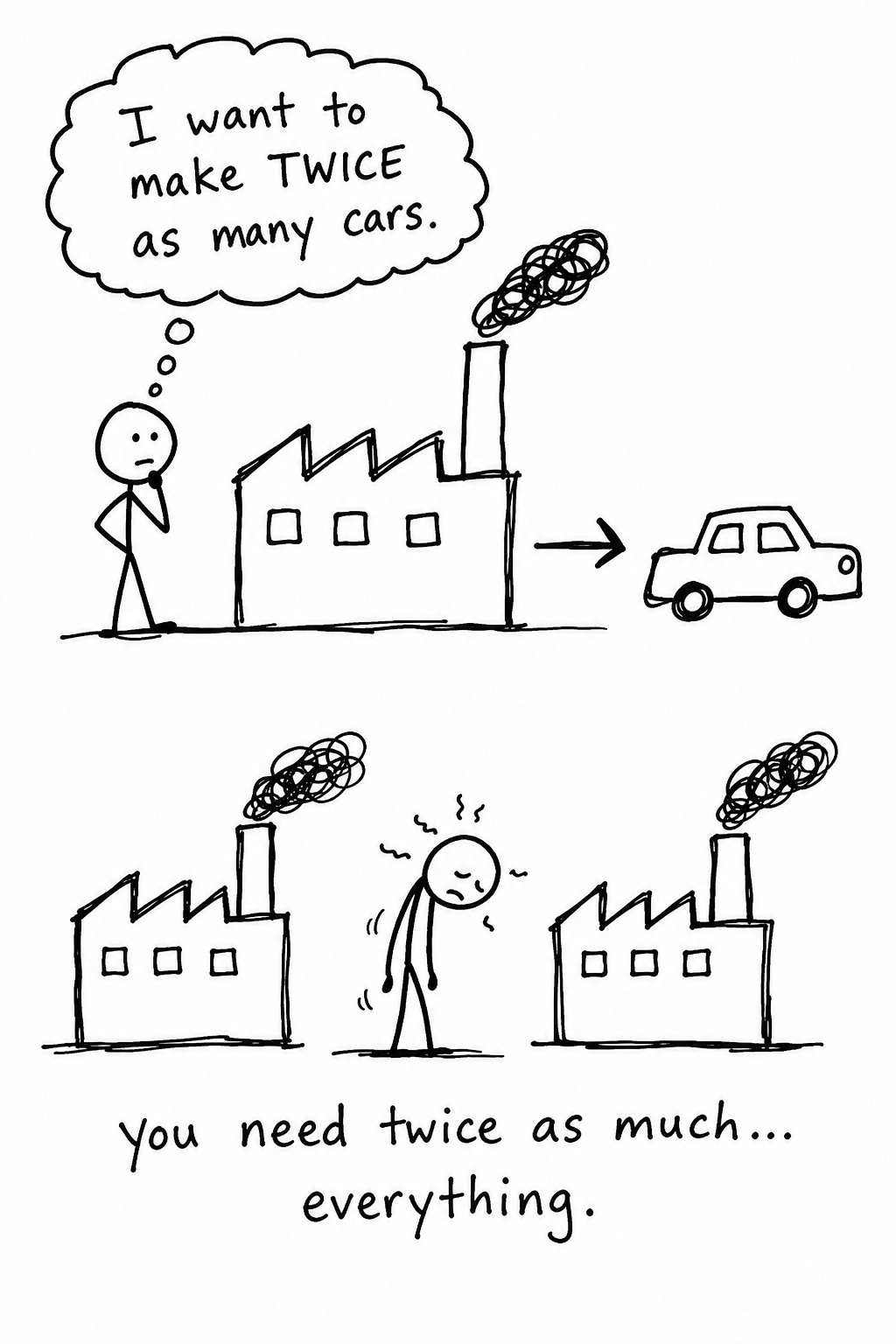
This linear scaling is the reason capital earns a return. You’re deploying a scarce resource. Your competitors need years and comparable investment to copy it. The gap between what your capital produces and what it costs to replicate is where your margin lives. Piketty’s famous r > g, the tendency of capital returns to outpace economic growth, rests on this scarcity. If anyone could copy your factory for free, competition would push your profit to zero. Econ 101.
For five hundred years, that “if” stayed in the textbook. No meaningful capital good could be copied at zero cost.
Then someone trained a large language model.
A trained AI model is, in economic terms, a capital good. It’s a productive asset. Feed it an input, it produces an output. Training one requires enormous upfront investment: hundreds of millions of dollars for a frontier model. In that respect, it looks like a factory. Large fixed cost, productive output, big investment to build.
But it has one property that no factory, no ship, no building, no railroad has carried in the history of economic production.
Serving one user and serving a hundred million users costs almost the same.
Arkwright’s mill couldn’t do this. Each additional customer meant additional spindles, additional cotton, additional labor, additional cost. Ford’s line couldn’t do this. Each additional Model T needed its own steel, rubber, paint, man-hours. But a trained AI model can serve a million users at once for a fractional increase in compute cost. Training the model is the fixed cost. Running it for each additional user is near-zero marginal cost. The model is an information good, and information goods follow different economics than physical goods. You can copy them. The copy performs as well as the original. The copy costs almost nothing to produce.
Consider what this does to Piketty’s equation.
r > g holds across five centuries of data because capital is scarce, hard to replicate, and risky to deploy. These constraints cap the return. Your factory earns well, but capacity limits the upside, and competitors can build their own. r exceeds g within bounds.
AI capital breaks those bounds.
When your “factory” is a model and your “product” copies to a billion users at near-zero cost, the numerator of your return (revenue from all those users) grows without limit, while the denominator (additional capital required to serve them) sits pinned near zero. For the handful of organizations that own frontier models and the compute infrastructure underneath, r is accelerating toward a number that the system, the institutions, the social contract, none of it was engineered to handle.
But the other side of this split matters more.
AI is compressing the returns on every other form of capital by dissolving the scarcity premiums those assets depend on.
Office towers earn their rents because knowledge workers need to gather in one physical room. If AI-coordinated distributed collaboration matches face-to-face productivity, the scarcity of prime urban office space fades. You’re paying $150 per square foot for a premise that weakens every quarter.
Big law firms bill high rates because legal analysis is scarce. Three years of law school, a decade of practice, and you’ve built expertise that’s hard to copy. If AI handles 80% of the legal research and document review that junior associates bill at $400 an hour, the billing pyramid that supports partner compensation loses its base. The senior partner’s judgment may retain value for a while longer. The structure funding it is contracting.
SaaS companies sell subscriptions because most businesses can’t build their own software. If AI assembles a custom application tailored to a specific workflow in an afternoon, the value of generic pre-built software drops. Why subscribe to a one-size-fits-all tool when you can have a tailored one for less?
Each case follows one logic: AI dissolves the scarcity that made the traditional asset valuable. The scarcity premium compresses. The return falls.
The picture that forms is a split in the nature of capital itself. One class of capital (AI models and the compute behind them) sees returns accelerating toward the upper bound of what the system can contain. Every other class (real estate, professional expertise, packaged software, conventional IP) sees returns falling as AI erodes the scarcity those assets depended on.
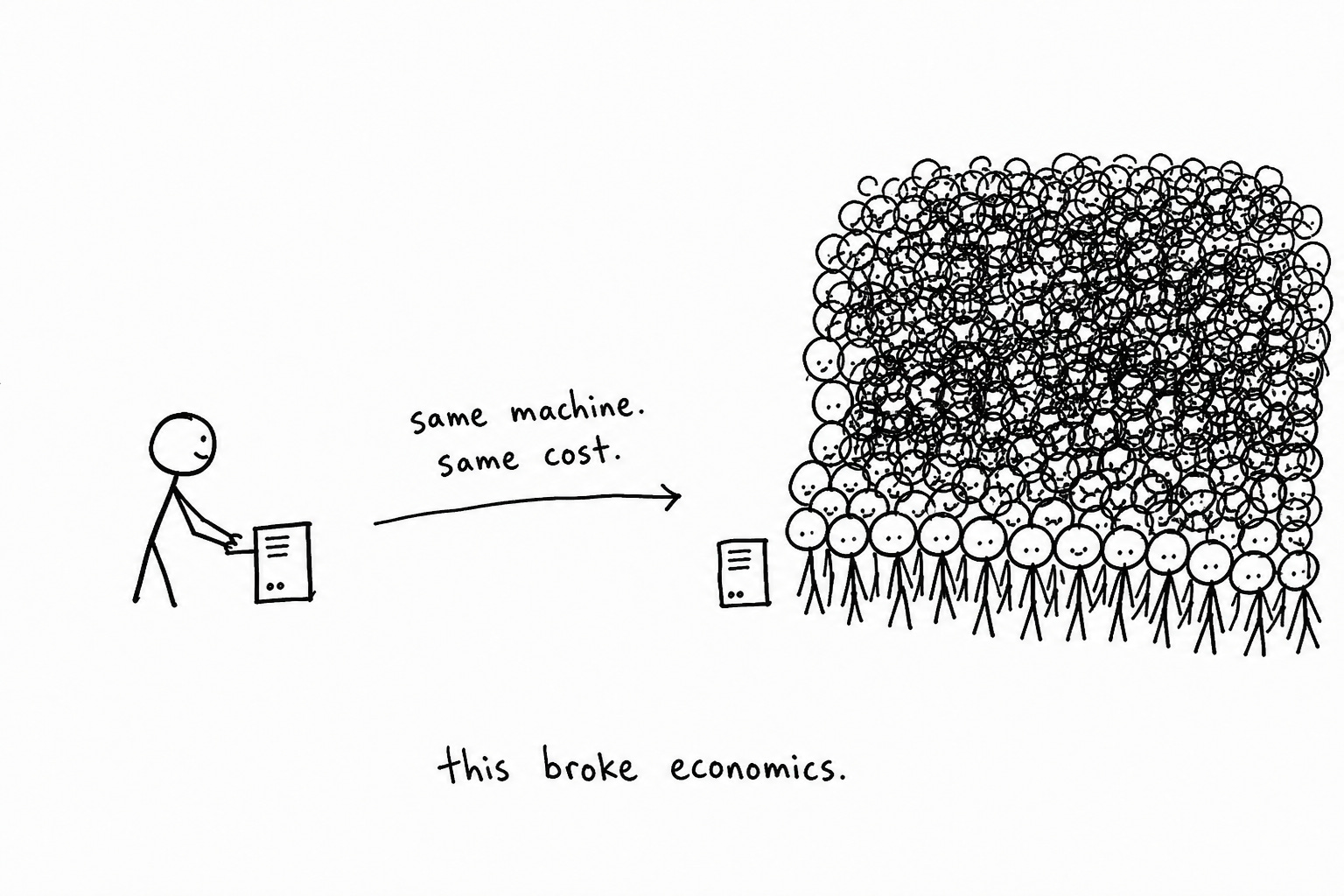
Piketty described a slow, generational process of wealth concentration. AI is switching it to fast-forward, and the acceleration runs in one direction: toward the handful of people who own the models.
Ownership Without Founders
I need a detour through history here. It connects to AI in a way that might not be obvious at first, but the connection is the crux of the problem.
Property rights feel natural, like gravity. You make something, you own it. But this feeling is recent. For most of recorded history, “ownership” meant something so different from the modern concept that the same word misleads.
In medieval Europe, land “ownership” was a layered, ambiguous web. The king “owned” all land in the realm in theory. Nobles “held” land from the king, as grants tied to military service. Peasants “used” land the nobles held, in exchange for labor and a share of the harvest. Nobody “owned” land in the modern sense: an exclusive, tradeable right, enforced by independent courts, that you can sell, bequeath, or pledge as collateral without asking permission from anyone above you.
The transition from feudal web to modern property took about three centuries. England’s Enclosure Acts, stretching from the 1400s through the 1800s, converted common grazing land into private farms. This process uprooted millions of families from the land their ancestors had worked for generations; those displaced families became the labor force for the Industrial Revolution’s factories. The English Civil War of the 1640s was, among other things, a property fight. The Glorious Revolution of 1688 settled key disputes about the relationship between crown and private ownership. France chose a faster, bloodier path: the Revolution of 1789 abolished feudal property in a single act, then spent a generation and the Napoleonic Code building a replacement.
The payoff of all that upheaval: clear, tradeable, court-enforced property rights. And those rights turned out to be the on-switch for the compound interest engine. England finished first. England industrialized first. The Homestead Act of 1862 turned the American West into private land, and capital flooded in behind the settlers. Japan’s Meiji Restoration rebuilt the property system, and within twenty years Japan had factories. The pattern repeats: property rights don’t follow economic growth. They precede it.
Now bring this to AI, and the problem comes into sharp focus.
A piece of code can be copyrighted. You wrote it; you own it. An invention can be patented. You designed it; the patent office grants exclusive rights for twenty years. A trade secret can be protected. You keep it locked up; law penalizes anyone who steals it. These tools handle 20th-century assets well. Clear categories. Clean boundaries.
But the capabilities that a frontier AI model develops after training on trillions of tokens: who owns those?
I keep pulling at this thread, and it doesn’t resolve.
The capabilities come from training data: trillions of tokens of text, books, papers, code, web pages, forum posts. Billions of people produced this material over decades. Most never knew their work was feeding a training pipeline. None gave consent. None received payment.
The capabilities come from architecture: researchers at Google Brain published the Transformer in a 2017 paper, built on decades of academic work in attention mechanisms and backpropagation, most of it funded by public grants and university budgets.
The capabilities come from compute: tens of thousands of GPUs running for months. NVIDIA designed the chips. TSMC fabricated them. ASML built the lithography machines. A global supply chain made the training run possible.
And the most valuable capabilities, general reasoning, creative generation, the ability to handle tasks nobody anticipated, nobody programmed in. They emerged. They arose from the interaction of data, architecture, and compute at a scale that crossed thresholds nobody predicted. No engineer coded “the ability to reason about contract law.” That ability showed up when the system got large enough and trained long enough on varied enough text.
These emergent capabilities can’t be traced to specific training data. They can’t be pinned to a specific architectural choice. They are collective phenomena, the whole exceeding the sum of its parts, in a way that existing intellectual property law was never designed to handle.
We’re looking at a new class of asset, a strong candidate for the most valuable asset class of the coming century. And the legal system of every country on earth lacks the tools to assign ownership of it.
In the absence of a framework, raw power fills the gap. The companies that train the largest models hold the capabilities the way a feudal lord held land: through possession and force of position. A lord’s title rested on armed men, not statute books. “This land is mine because my soldiers say so.” It worked for centuries. It was incoherent in principle.
As economies grew and more parties developed stakes in how land was used (merchants wanting to buy it, creditors wanting to lend against it, tenants wanting security), disputes accumulated with no legitimate resolution mechanism. The pressure built until the system either reformed through legal invention (England’s path, slower, less blood) or shattered through revolution (France’s path, faster, far more blood).
AI’s property vacuum is the same type of problem. “Whoever has the compute” settles the ownership question today. But that settlement won’t hold. Too many stakeholders have too much at stake: the billions of people whose data trained the models, the taxpayers who funded the foundational research, the governments that want oversight, the competitors who want access, the users who depend on the output. As the economic value of AI capabilities grows, the gap between de facto ownership and legitimate ownership will widen. And widening property gaps don’t resolve themselves on their own. They never have.
The Player With X-Ray Glasses
Back to the poker table.
Millions of players, different cards, overlapping bets. The table works because of one condition so basic that nobody at the table thinks about it:
Each player reads and processes cards at about the same speed and depth.
You might be sharper than me. Better instincts, more experience, faster math. But the gap between us is a gap of degree. We’re both human. Both running the same type of biological hardware. Both contributing to the price signal through our bets.
Now picture a new player taking a seat. This player wears glasses that let him see through the backs of every other player’s cards.
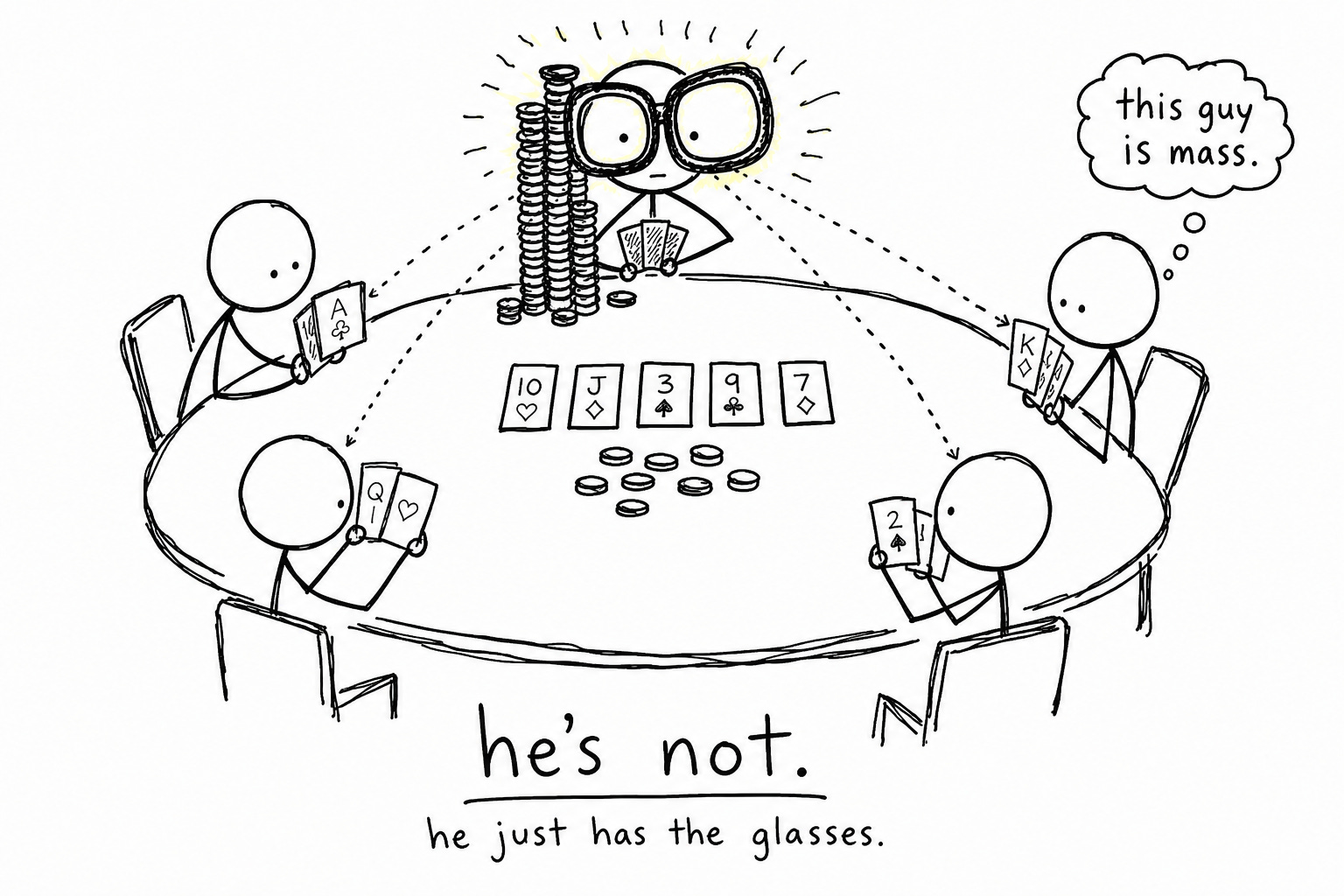
Nobody else knows about the glasses. The game continues. Cards dealt, bets placed, chips moving. Walk into the room and you’d see a normal poker game.
But the game’s structure has changed. The player with X-ray glasses reads every hand, calculates every probability, bets with certainty against opponents who bet with uncertainty. No skill required. No insight. The glasses do the work. Chips flow, with mechanical regularity, from every other seat toward his.
The table “works” in the sense that transactions occur. It has stopped working in the way that once mattered: as a fair contest where the prices that emerge reflect the collective judgment of many independent minds.
AI is the glasses.
A hedge fund’s AI system scans the full order book across global markets in milliseconds. It cross-references satellite images of retail parking lots, credit card spending data from consumer panels, sentiment analysis of earnings call transcripts, supply chain shipping logs. Then it executes. Ten rounds of trades in the time it takes a human analyst to read a single page of a 10-K filing.
The gap between this system and a human analyst is a gap of kind. A good analyst and a great analyst differ in degree; they’re both human, reading with human eyes, thinking at human speed. An AI system perceives dimensions of the data that the human brain, as a biological instrument, cannot access. The word is “cannot,” not “can, at a slower speed.”
This distinction has a sharp edge when it comes to regulation.
Traditional information asymmetry (I know something you don’t) responds to existing tools. Insider trading laws. Mandatory disclosure rules. Force companies to publish financials, and the information playing field levels.
Processing asymmetry (we hold the same data, but one of us can extract patterns from it that the other’s brain can’t perceive in principle) doesn’t respond to disclosure. The data is already public. The 10-K is on the SEC website. The satellite images are for sale. The gap isn’t in what each player has. It’s in what each player’s cognitive machinery can do with it.
The fix for information asymmetry: give everyone the same data.
The fix for processing asymmetry: give everyone the same AI.
No financial regulator on earth is set up to do that. No law on the books imagines it. The tools we built to keep the poker table fair, disclosure rules, insider trading enforcement, market surveillance, all assume that the players are the same kind of entity. Humans, with human brains, competing on human judgment. That assumption is expiring.
And the dynamic extends beyond financial markets.
In labor markets: when an employer’s AI can gauge a worker’s output, predict their future performance, and compute the minimum salary the worker will accept, all with precision no HR team can match, wage negotiations stop being negotiations. They become an optimization exercise run by one side’s machine against the other side’s gut. The “price” of labor starts reflecting the employer’s AI mapping the worker’s tolerance for being underpaid.
In real estate: when an AI models neighborhood trajectories, zoning changes, demographic shifts, and infrastructure investments with precision no individual buyer can match, property prices stop reflecting “the market’s view.” They reflect the view of whoever runs the best model. You walk through an open house and form a gut estimate. An institutional AI has already analyzed twenty years of sales on that block, every zoning filing, three bus route changes, and a Census Bureau migration dataset. It placed its bid before you turned the key in your car.
Transactions keep happening. Prices keep moving. The table looks the same. But hand by hand, it is shifting from a game where collective judgment sets fair prices toward a mechanism where the player with the best glasses extracts from everyone else.
Three Exit Scenarios
I don’t know which of these we’re heading toward. I do know that the people who sound most confident about the answer are the ones whose confidence I trust least.
But I can push the three mutations to their structural endpoints and lay out the territory each one points toward. Think of these as the way a VC might think about exit scenarios for a portfolio company. Except the company is the global economic order, and the portfolio is your life.
The Velvet Cage
The compound interest engine keeps running. Returns collect in the accounts of AI model owners. Most people live in material comfort because AI productivity keeps goods cheap. Food affordable. Housing adequate. Healthcare delivered by AI diagnostics at low cost.
But economic sovereignty evaporates.
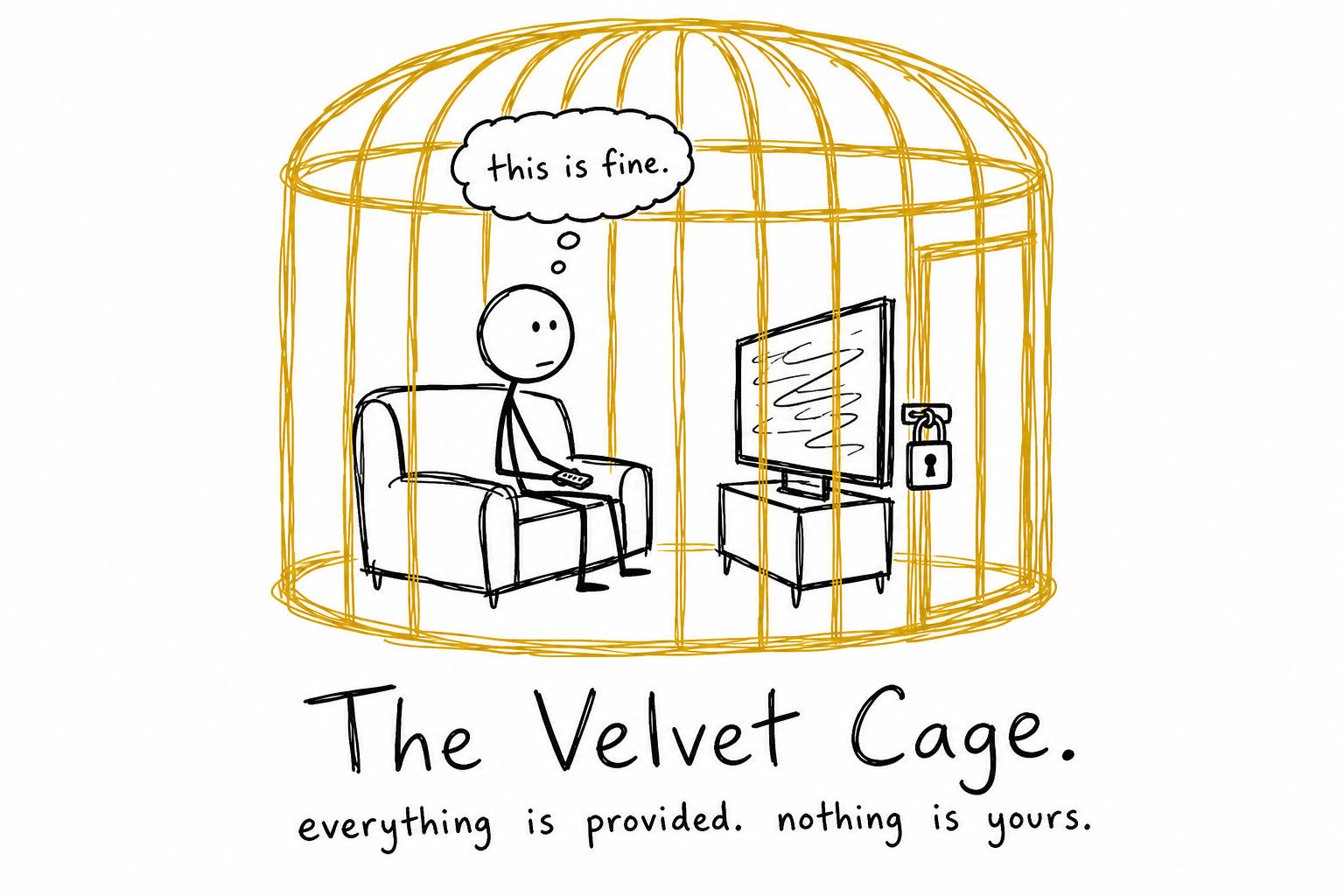
You work on an AI-owner’s platform because outside it the economy has thinned to the point where competitive alternatives barely exist. You consume through it because AI-produced goods undercut every rival on both price and quality. Your information, entertainment, and social connections run through AI curation because the curated version, by every measurable standard, outperforms the uncurated one.
You’re not poor. You’re not hungry. No one holds a weapon on you.
But every axis of your economic life runs on infrastructure someone else owns, and no meaningful alternative exists.
The historical parallel is the medieval manor. Feudal peasants were not, as a rule, starving. They had land, communities, festivals. Feudalism’s defining trait was structural dependency: your economic life was shaped by your relationship to the lord’s land. You couldn’t choose your employer or negotiate your terms.
Replace “land” with “AI platform.” The architecture rhymes.
And this doesn’t require a villain. It’s the natural arithmetic of compound interest under AI conditions. Medieval feudalism wasn’t “designed.” It was the equilibrium that military power and land distribution produced over centuries. Nobody planned it. Everybody ended up in it.
The Fork
If augmentation technologies arrive, brain-computer interfaces, cognitive enhancement, deep AI-human integration, the gap between enhanced and unenhanced humans could shift from degree to kind.
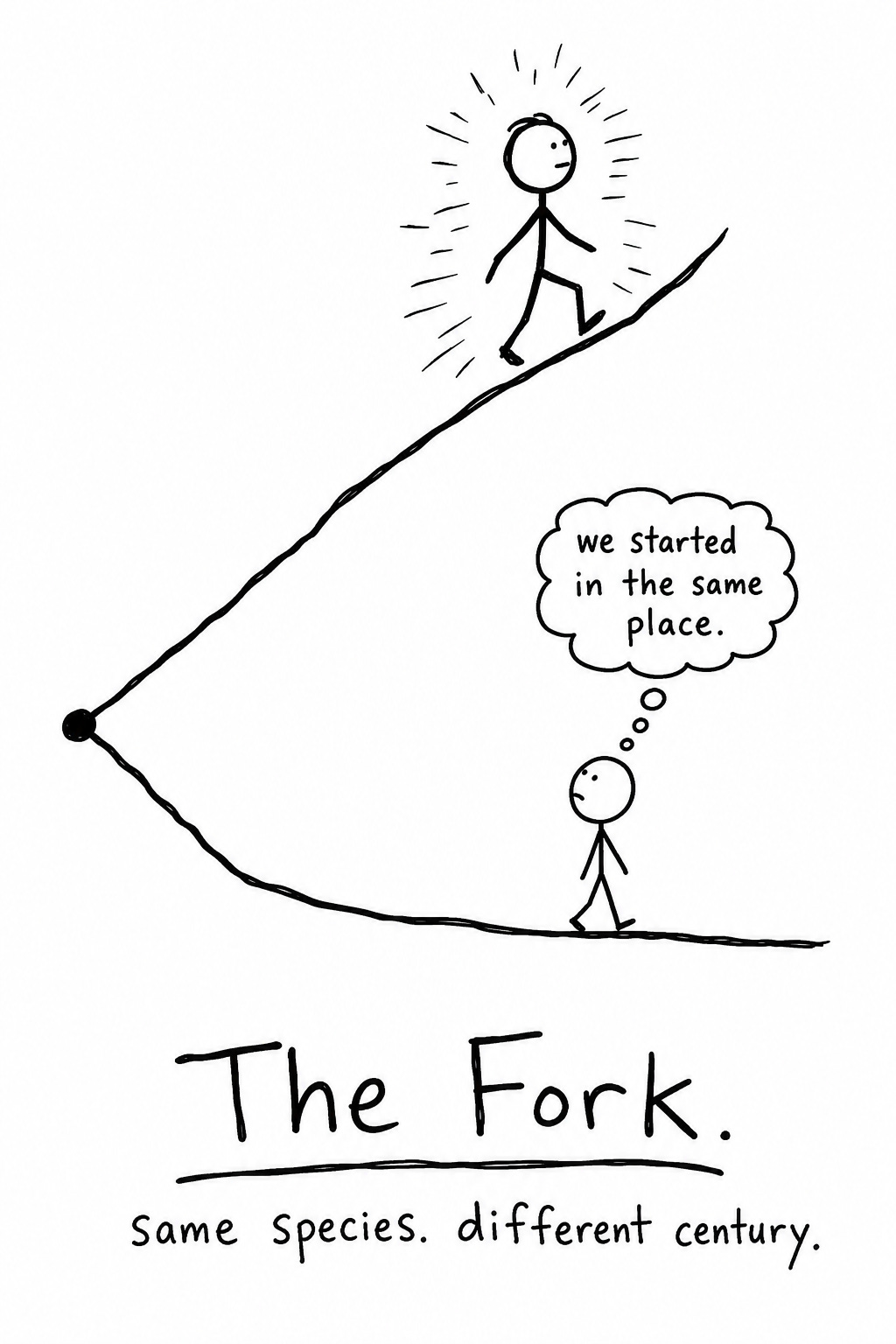
Some people learn ten times faster, analyze with a hundred times more precision, synthesize across a thousand times more dimensions. Their interface with AI runs deeper, and that depth creates the gap.
Compound interest accelerates in the upper stratum. The lower stratum doesn’t get oppressed. It gets outpaced. Two economies, two societies, decoupling over time.
A civilization splitting along lines of cognitive architecture rather than geography, culture, or class. One species. Two trajectories.
The Bismarck Option
In 1883, Otto von Bismarck, a Prussian aristocrat who viewed socialists with open contempt, built the world’s first national social insurance system. State pensions. Accident insurance. Health coverage for workers. He did this because the Social Democratic Party was gaining seats in the Reichstag, factory strikes were disrupting the economy, and he needed a valve to release pressure before it blew the system apart. His calculation: keep the engine running, but give workers enough security that they stop voting for people who want to tear it down.
Bismarck didn’t scrap the engine. He bolted a redistribution module onto it: small enough to preserve performance, large enough to absorb the political pressure that was building toward revolution. Franklin Roosevelt ran a similar play with the New Deal in the 1930s. Postwar Western Europe ran it again with the welfare state.
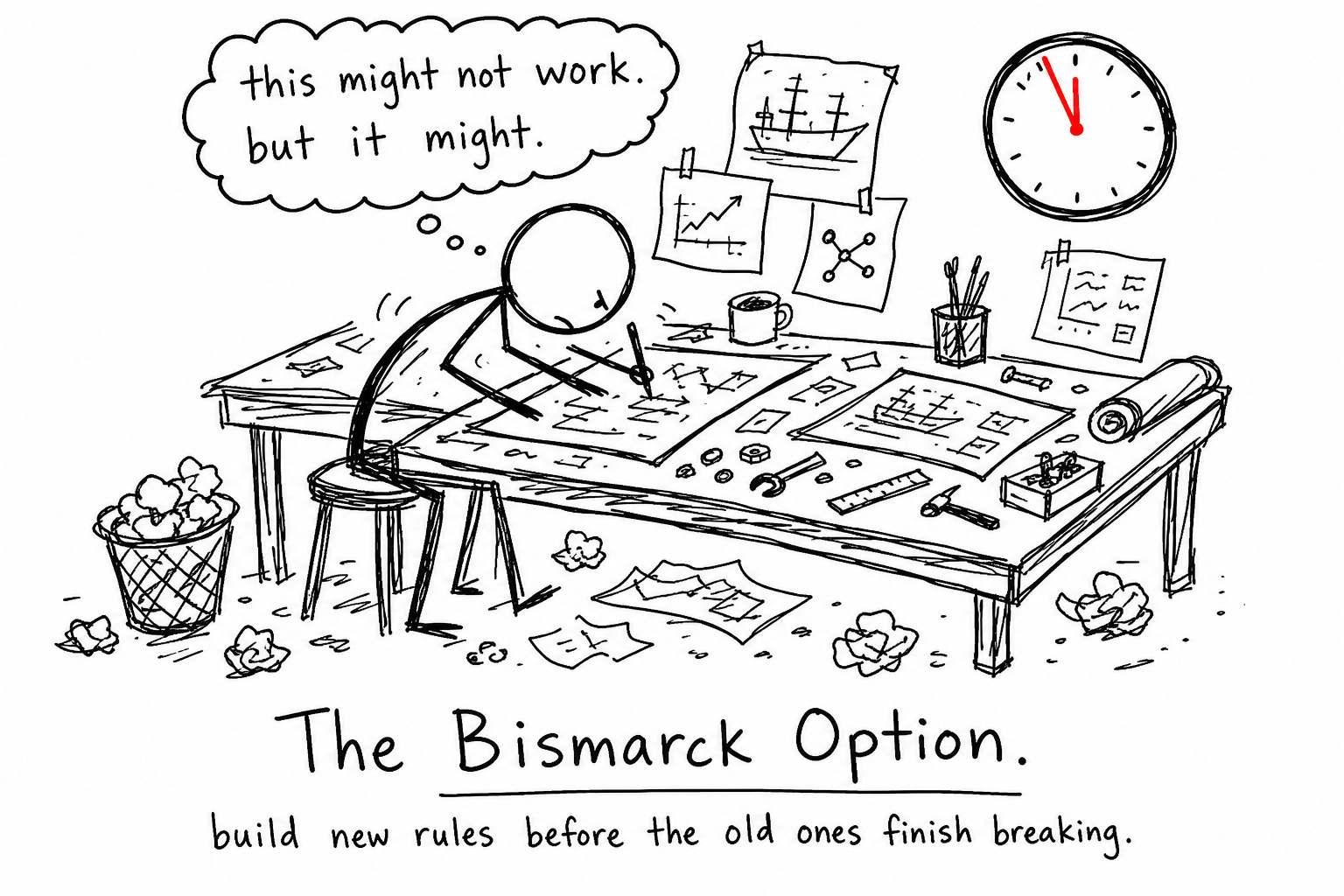
AI may need a play from the same playbook, in a form nobody has invented yet. Compute as public infrastructure, like roads and power grids. Distribution mechanisms embedded in AI systems, routing a fraction of every AI-generated dollar back to the data contributors who made the system possible. A new form of property right that can handle emergent capabilities the way copyright handles creative expression and patents handle inventions.
This is the best exit. It’s also the hardest to reach, because it demands institutional innovation at the speed of technical change.
The historical scorecard on that race offers no comfort.
Industrial production methods reshaped England starting in the 1780s. Matching institutions, factory acts, union legalization, social insurance, universal suffrage, the welfare state, arrived around the 1940s. The gap between the technology and the institutions: about 160 years. In that gap: the final phase of the Enclosure Acts, the Chartist movement, the failed revolutions of 1848, the Paris Commune, two world wars, the Great Depression, and fascism on three continents.
The institutions caught up. The catching-up killed tens of millions of people.
How much time do we have this round? A generation, maybe. Maybe less.
I keep coming back to that sidewalk on Central Park South.
Mamdani pointing his camera at 24,000 square feet of empty penthouse. Griffin calling it dangerous. Ackman tweeting. The news cycle grinding. Left versus right. Populism versus capital. The same script running since the 19th century.
But the thing that makes this moment different from every previous round of this fight is the engine underneath it. The engine that made Griffin’s $238 million possible. The engine that makes Mamdani’s tax revenue possible. The engine that built the city both of them are standing in.
That engine is mutating. AI is pushing its returns past the limits it was built for. AI is creating assets that the property framework can’t define. AI is seating a player at the poker table who can see through the cards.
Mamdani thinks he’s fighting a tax fight. Griffin thinks he’s fighting a capital-mobility fight. They’re both right, in the same way that two people arguing about the arrangement of deck chairs are right about which chairs look better where.
The ship is the thing.
Glushkov believed, in 1962, that computation would save socialism. He spent a career on this conviction. The idea that computation might pose the deepest challenge to capitalism never entered his work.
I don’t know which exit scenario we’re headed for. I don’t think anyone does, and I distrust anyone who claims certainty. I do know this: the frameworks we’re using to debate the moment, socialism versus capitalism, left versus right, regulation versus free markets, were forged in the Industrial Revolution to handle that transformation’s problems. They did the job. With enormous pain and delay, they did it.
The problems arriving now are different in kind. The capital is different: it copies itself. The property is different: existing law can’t define it. The market is different: some players see through the cards.
We need new frameworks. We need a new term sheet for the 21st century. Mamdani and Griffin are both arguing over the old one, and I can’t fault either of them, because the new one doesn’t exist yet.
The question is who writes it, and how fast.
The last time the engine mutated, in the 1780s, the new term sheet took 160 years to arrive. The wait included the most destructive events in human history.
The engine is mutating again. Faster this time.
I’d prefer not to wait 160 years.
I don’t think we have them.
I'm not sure how compute can be "owned." Models can be copied. Deepseek isn't as good as Claude, but is it a difference in kind or magnitude?
As the supply of something increases, cost decreases. If the supply of compute increases, then who is going to get rich "owning" compute?